
Abhishek slaps 10-crore defamation notice on Madan Mitra over 'murderer' jibe
.gif)

Download Mobile App 






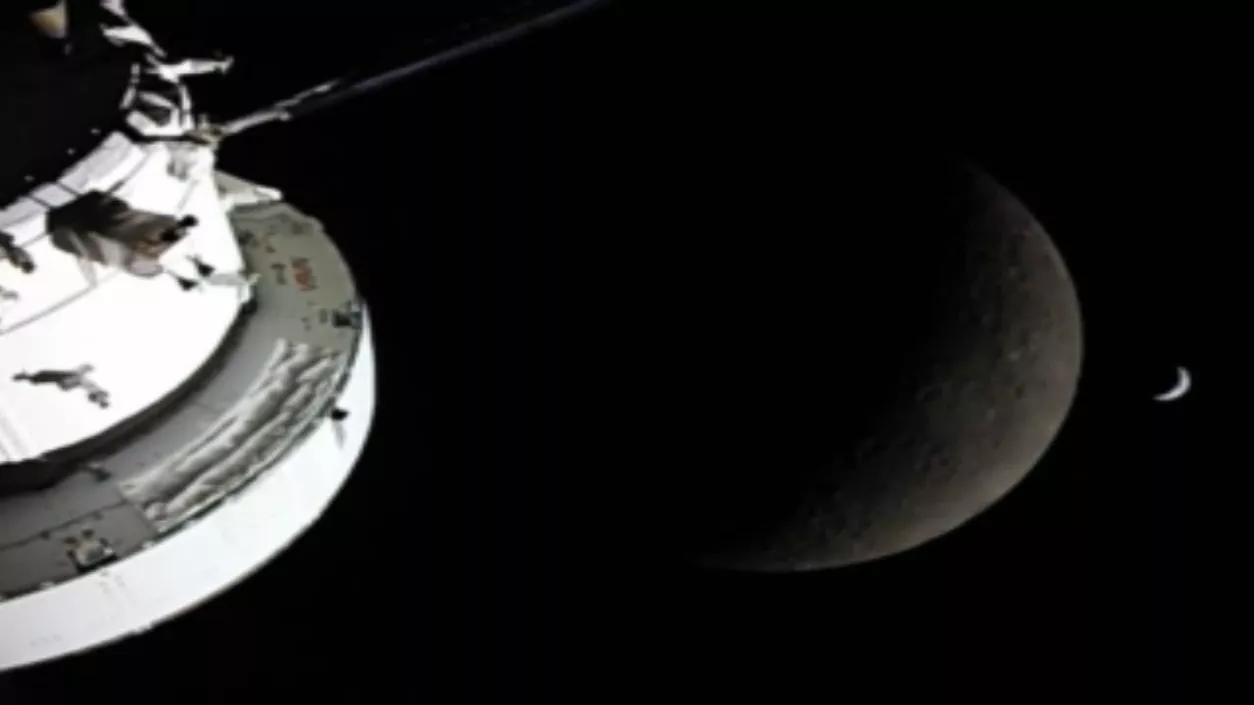
NASA’s Artemis II mission has achieved a historic milestone by completing a record-breaking journey around the moon, surpassing the distance record set by Apollo 13 in 1970. The crewed Orion spacecraft reached a maximum distance of 252,756 miles from Earth during its lunar flyby, marking humanity’s farthest journey into space. The mission represents a significant step in NASA’s return to the moon after more than five decades.
The highlight of the mission was a seven-hour flyby of the moon, during which the astronauts observed and documented the lunar far side in unprecedented detail. The crew, comprising three American astronauts and one Canadian, captured extensive imagery of the moon’s surface, including prominent geological features such as the Orientale Basin. They also reported witnessing striking visual contrasts, with some lunar peaks appearing bright enough to resemble snow under sunlight.
During the mission, the crew experienced a 40-minute communication blackout as the spacecraft passed behind the moon, reaching its closest approach of approximately 4,067 miles from the lunar surface. Utilizing a free-return trajectory, the spacecraft leveraged gravitational forces from the Earth and moon to navigate its path without the need for additional propulsion, setting it on course for a safe return journey.
The astronauts also marked an emotional moment during the mission by proposing names for newly observed lunar craters, honouring both their spacecraft and personal connections. The journey was further enriched by symbolic gestures, including carrying a historic Apollo-era patch and receiving a recorded message from a former Apollo astronaut, reinforcing continuity between past and present lunar missions.
Artemis II is the first crewed lunar mission since 1972 and is a critical precursor to upcoming missions aimed at establishing a sustained human presence on the moon. With plans already in place for future missions involving lunar landings near the south pole, the success of Artemis II signals a major advancement in deep space exploration and international collaboration.





.webp)

.webp)


 West Bengal
 Bihar
Bihar Uttar Pradesh
 Jharkhand